Ideas often begin as simple sparks inside the classrooms of the College of Information Technology—shared during discussions, refined through feedback, and expanded during hands-on activities. But in CIT, these ideas are not expected to stay within four walls. Through the SPARK Program (Shaping Professionals through Active Research and Knowledge-Sharing Initiatives), students are encouraged to develop their concepts beyond class requirements and turn them into solutions that address real needs.
SPARK provides platforms where these ideas can be showcased and tested. The department’s public research presentations allow students to present their work to a wider audience, gaining insights that help refine their projects. The program also motivates students to pursue published research and participate in both local and national innovation competitions, reinforcing the value of sharing knowledge and contributing to the broader IT community.
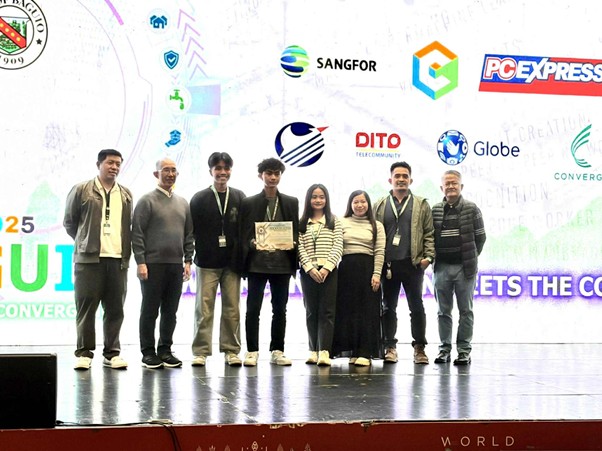
Over the years, since CIT was established, its students have consistently shown what can happen when classroom ideas are given space to grow. They have placed in competitions such as the DICT’s Start-Up Challenge in 2023, Y4IT 2024, Start Up Challenge 2025, and they continue to expand the college’s presence in the field of innovation. Most recently, another group of CIT students earned recognition as one of the top teams in the Smart City Challenge of Baguio City, competing under the Technological Urbanization Category—a clear reflection of what happens when ideas are nurtured, shared, and brought to life.

The team is composed of 3 students, Bhenny Benlor Rivera, Blessed Joshua Bustamante, and Lryn Cuyangan, all third-year IT students who also serve as officers of the college student organization S-ALT. Drawing from their experiences inside and outside the classroom, they developed TIGNAY (Technological Integrated Guidance Navigation and Yield), a mobile application concept designed to respond to navigation challenges often encountered in local settings. Unlike typical navigation platforms, TIGNAY focuses on context-specific issues such as limited road data, inconsistencies in routing, and the lack of real-time guidance tailored to community-level mobility. The name itself, tignay, an Ilocano term meaning to move or take action, reflects the project’s intention to encourage more responsive and community-aware technological solutions.
During the Smart City Challenge of Baguio City under the Technological Urbanization Category, their clear articulation of the problem and practical approach to addressing it earned them Third Place in the recently concluded awarding ceremony at the Baguio Convention Center. Their work demonstrates how student-led ideas can translate into solutions with potential real-world relevance.
The group’s work benefited greatly from the guidance of Ms. Marielle Angela Fianza-Buya, whose consistent feedback and direction helped strengthen the concept and align it with the competition’s goals. Mr. Ginard Guaki and Mr. Ralphy Jun Luzada also served as mentors, offering additional insights that supported the team in sharpening both their technical approach and overall delivery. The College acknowledges the support provided by King’s College of the Philippines, as well as the City Government of Baguio, whose initiative continues to give students opportunities to develop and present solutions that address real urban challenges.
As the Smart City Challenge concludes, the work of these students reinforces an important message: ideas formed in the classroom do not have to end there. With the right avenues, guidance, and determination, student concepts can evolve into contributions that reach beyond academic requirements and into spaces where they can create meaningful impact.